
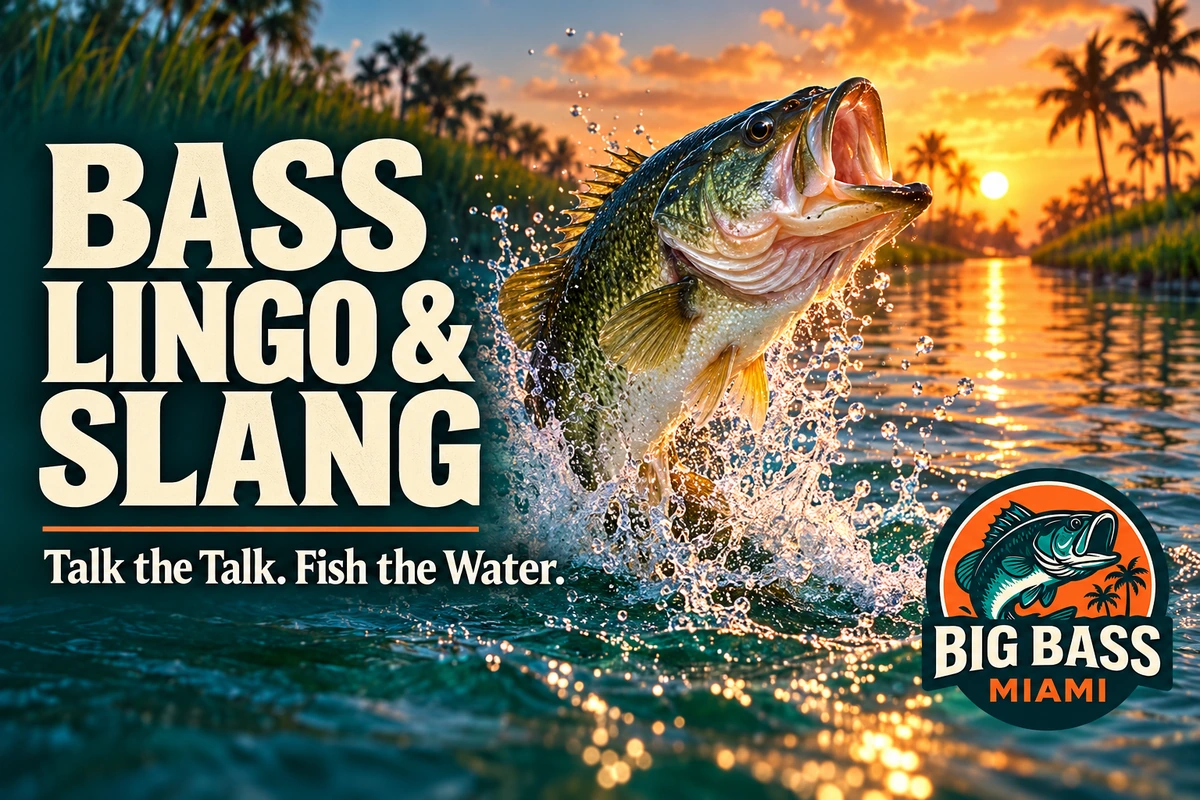
“That’s a hog!”
If you’re new to bass fishing, you might look around for something other than a fish. But when an angler says it with a bent rod and a grin, you’ll understand soon enough.
Bass fishing comes with a language of its own. A big fish becomes a lunker. A little one becomes a dink. And the bass that disappears beside the boat? That one usually gets bigger every time someone tells the story.
You’ll hear these expressions along canal banks, at boat ramps, and in conversations that start with, “You should’ve seen the one I caught.” Some words describe the fish. Others describe the bite, the tackle, or how the day went.
You don’t need to memorize them before making your first cast. But learning a few makes fishing conversations easier to follow—and gives you another way to enjoy the stories.
Why One Bass Has So Many Names
Ask five anglers to describe a big bass, and you might get five different answers.
One caught a hog. Another landed a tank. Someone else swears it was a toad. Chances are, they’re all describing the same thing: a fish that made them stop and reach for the camera.
Most of these nicknames have no official weight attached to them. A lunker isn’t a certified size category, and nobody checks your scale before you call a bass a pig. The meaning depends on the angler, the water, and the moment.
Your first three-pounder might feel enormous. Someone who regularly catches larger fish may call it a nice chunk. Both reactions belong in fishing.
That’s part of the fun. The scale gives you a number. The nickname tells you how the catch felt.
The Big Bass Nicknames
These are the words that tend to come out when a fish gets everyone’s attention.
- Big’in / Biggun: A casual way of saying “big one,” often spoken before anyone has seen the whole fish.
“Get the net—that’s a biggun!” - Hog / Hawg: A favorite nickname for a big, heavy bass. The spelling changes; the excitement stays the same.
“There was a hawg tucked against that grass edge.” - Lunker: A classic fishing word for an impressively large fish.
“That’s a proper lunker. Let’s get a weight on it.” - Pig: Usually a thick, hefty bass that looks like it has been eating well.
“Look at the shoulders on that pig!” - Tank: A powerful-looking fish with plenty of bulk.
“That thing’s built like a tank.” - Mule: An emphatic nickname for a big fish, especially one that puts up a stubborn fight.
“I thought I was snagged until that mule started pulling.” - Toad: A chunky, impressive bass. No hopping required.
“That’s a toad! What did you catch it on?” - Slob: An affectionate name for a particularly heavy bass. It sounds insulting, but anglers usually mean it as a compliment.
“One bite all morning, but it was an absolute slob.” - Donkey: Another larger-than-life name for a fish that stands out from the rest.
“That donkey made the whole trip.” - Monstah: “Monster,” delivered with extra personality. Picture an excited fishing buddy stretching out the word while everyone gathers around.
“Would you look at that monstah!” - Whopper: An unusually big fish, with no set weight needed to earn the name.
“That bass was a whopper!” - Whale: Fishing exaggeration at its finest. You caught a bass, but for a few seconds, it felt considerably bigger.
“Something hit my bait like a whale. I’m still trying to settle down.”
The Everyday Fish Count, Too
Every catch doesn’t need to be a personal best. Some of the most useful fishing words describe the ordinary fish that keep a day interesting.
- Chunk: A solid, stocky bass. It may not be huge, but it’s a satisfying catch.
“Nice little chunk to start the morning.” - Bucketmouth: A nickname for a largemouth bass, inspired by that unmistakably oversized mouth. It describes the fish more than its weight.
“There’s the bucketmouth we’ve been looking for.” - Dink: A small bass, usually mentioned with a laugh.
“Another dink—but at least we know they’re biting.” - Schoolie: A fish associated with a school or group. Some anglers use it for smaller schooling fish, although the meaning varies by fishery and region.
“A few schoolies started chasing bait along that bank.” - Keeper: A fish that meets the size requirements for the situation being discussed, often in tournament conversation. The word alone doesn’t establish whether a fish may legally be kept; current rules depend on the species and water you’re fishing.
“That looks like a keeper for the tournament—better check the board.”
At Big Bass Miami, a bass doesn’t have to earn a big nickname to deserve careful handling. Even the smallest dink has a place in the water—and sometimes a starring role in a good story.
Beyond the Fish: What Anglers Say About the Day
Once you recognize the fish nicknames, you’ll start hearing another layer of conversation. These phrases help describe what happened between the first cast and the walk back to the truck.
- Blowup: A sudden, splashy strike at a bait on the surface. A blowup doesn’t always end with a hooked fish.
“Did you see that blowup beside the pads?” - Bird’s Nest: A tangle of line on a reel, commonly associated with a baitcaster backlash.
“Give me a minute. I’m picking out a bird’s nest.” - Skunked: Finishing a fishing trip without catching a fish. Most anglers know this one from experience.
“Beautiful morning, but I got skunked.” - Confidence Bait: A lure you trust and reach for when you need to settle in and fish with purpose.
“When the bite gets tough, that worm is my confidence bait.” - Reaction Bite: A strike anglers describe as a quick response to a lure’s movement or sudden appearance.
“That fast retrieve seemed to trigger a reaction bite.” - Personal Best / PB: Your biggest catch of a particular species, usually measured by weight or length.
“That might be my new largemouth PB.” - The One That Got Away: A fish you hooked but didn’t land—and a story that may follow you home for years.
“I’m happy with what I caught, but I’m still thinking about the one that got away.”
Same Language, Different Banks
Fishing slang travels, but it changes along the way.
A word you hear constantly on one canal bank might get a puzzled look somewhere else. Some anglers call every impressive fish a hawg. Others save lunker for something truly special. Friends develop their own expressions, and eventually a nickname from one memorable afternoon becomes part of every trip.
Here in South Florida, those conversations might happen beside a neighborhood canal, along a lake, or after a morning in the Everglades. The setting changes, but the conversation often starts the same way:
“Any luck?”
From there, it might turn into a lure recommendation, a story about a missed strike, or a friendly debate about just how big that last fish really was.
You don’t have to sound like an experienced angler to join in. Ask what a word means. Share what you noticed. Most fishing stories have room for one more person.
A Good Story Starts With Respect
We enjoy the nicknames, the excitement, and the occasional generous description of a fish’s size. They give bass fishing some of its personality.
But once the laughter settles, the same principles still matter: respect the water, handle the fish with care, and take your discarded line home.
Enjoy the catch. Get your picture when you can do so responsibly. Then give the fish the attention it deserves.
The story will still be there to tell afterward.
What Do You Call a Big Bass?
Did we miss a favorite? Maybe your fishing buddy has a name for a big bass that deserves a place on this list. Maybe your family has used the same expression for years, and you’ve never heard it anywhere else.
Head over to the Big Bass Miami contact page and send it in. Tell us the word, what it means, and how you’d use it. If there’s a good story behind it, we’d like to hear that, too.
Tight Lines and Good Times!