
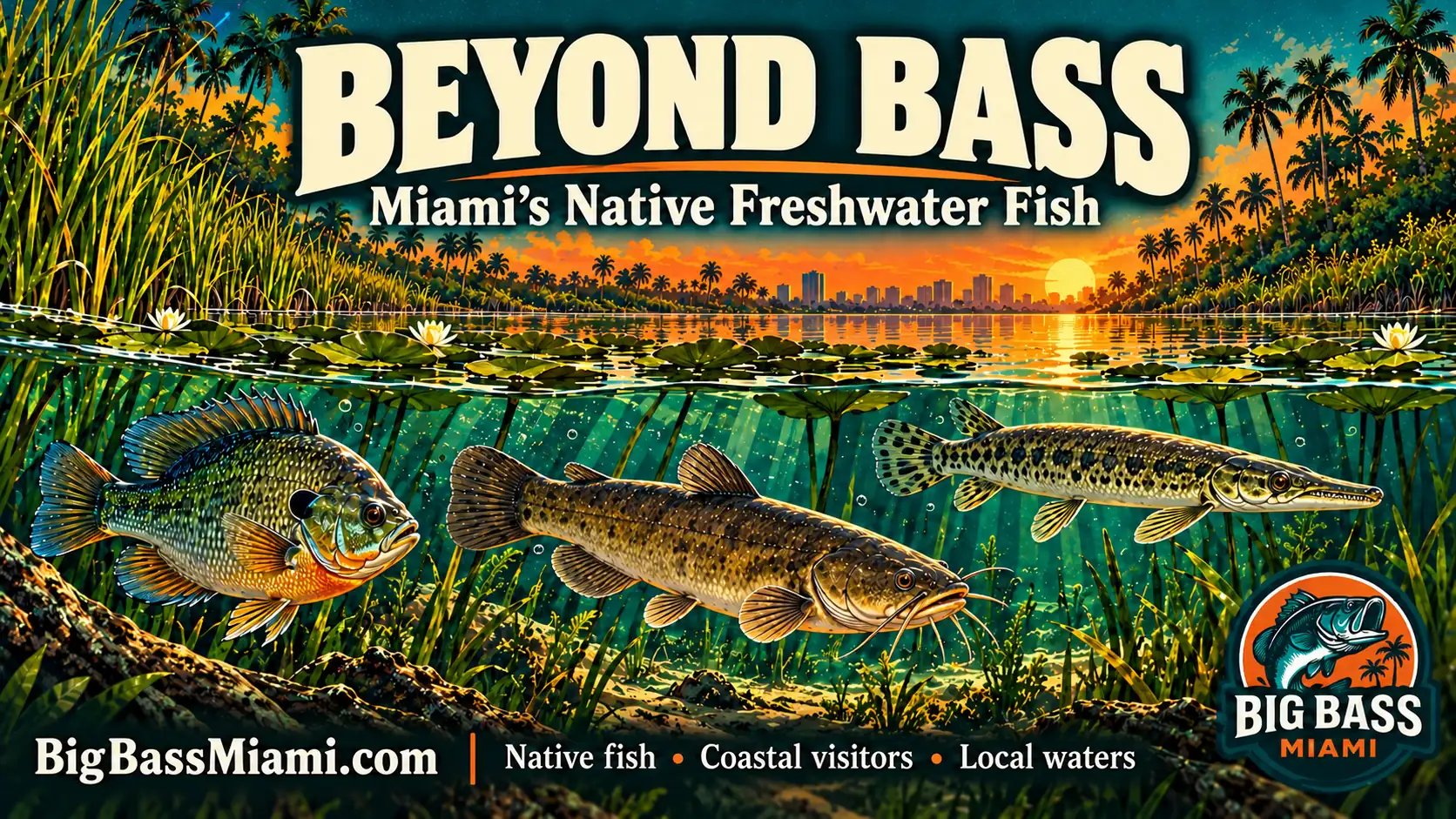
The featured artwork and species images are illustrations. Select a species image to enlarge it.
Bass might bring us to the water, but they're only part of the story. This guide to native freshwater fish of Miami explores canals, lakes, and nearby Everglades habitats and the species that call them home. Some fit neatly into the panfish category. Others have teeth, armor, or enough strength to surprise someone fishing for bass.
This guide introduces nine native freshwater fish, plus three native coastal species that enter fresh or brackish water, which you may encounter in the Miami area and surrounding South Florida waters. Their presence varies by waterway; this is a starting guide, not a complete inventory.
Bluegill (Bream)

Bluegill are a familiar starting point for freshwater fishing. Look for a deep, flattened body, a dark ear flap, and a dark mark near the back of the dorsal fin. Color varies, so don't rely on a blue cheek alone.
Lakes and ponds provide good habitat. A small piece of worm or a cricket beneath a float offers a simple approach. Small spinners can also make light-tackle fishing enjoyable. Keep the hook and bait small enough for the fish's mouth.
Source: FWC bluegill profile.
Redear Sunfish (Shellcracker)

The shellcracker gets its nickname from its appetite for snails and other shelled food. A red or orange edge on the dark ear flap helps distinguish it from other sunfish.
Redear favor hard bottoms and often use deeper water than bluegill. Earthworms are a dependable bait to try. Let the presentation reach the area you're fishing rather than assuming every panfish feeds just below the surface.
Source: FWC redear profile.
Warmouth

Warmouth are stocky native sunfish that favor vegetation, submerged wood, and sheltered water. Their relatively large mouth helps set them apart from smaller-mouthed panfish.
Look for suitable cover in canals, marshes, and slow-moving water. Worms and other small panfish baits are sensible choices. Work openings near cover instead of overlooking them while casting toward open water.
Source: FWC warmouth profile.
Spotted Sunfish (Stumpknocker)

Small spots arranged along an olive-to-brown body give the spotted sunfish its name. Anglers also call it a stumpknocker. It is a native sunfish, not a young tilapia or an unusually marked bluegill.
This smaller fish adds another reason to look closely at a panfish catch before identifying it. For an exploratory light-tackle approach, start with a small hook and a small piece of worm around accessible cover.
Sources: FWC spotted sunfish profile and South Florida fish overview.
Black Crappie (Speckled Perch)

Black crappie (Pomoxis nigromaculatus), known locally as speckled perch or specks, are native Florida sunfish. A deep, silvery body with irregular dark speckles and nearly symmetrical dorsal and anal fins helps identify them.
Unlike many other panfish, crappie spend much of their time offshore in lakes and large, slow-moving clear rivers, feeding on small fish. They occur in South Florida, including the Everglades region, but their presence varies by waterbody. Look beyond shoreline cover when learning where they gather.
Specks are a cool-weather favorite with Florida anglers. Small jigs and minnows are familiar presentations; finding the depth of a school can matter more than casting toward every patch of bank vegetation.
Sources: FWC black crappie profile, FWC crappie fishing guide, and Florida Museum black crappie identification and range.
Chain Pickerel

Chain pickerel (Esox niger) are native Florida predators with an elongated body, a toothy snout, and distinctive dark, chainlike markings along their sides. Their dorsal and anal fins sit far back near the tail. FWC lists them statewide in vegetated lakes, swamps, and river backwaters.
A native fish I remember: When I was a kid, we caught chain pickerel more often. I've spent many years fishing since then without catching another one, and I rarely hear anyone mention them when talking about Miami freshwater fishing. For me, a chain pickerel would be a very rare catch today—and a reminder of a native fish many local anglers may have never encountered.
That recollection reflects my own fishing experience; it doesn't establish a change in their local population. Bass anglers may encounter pickerel on spinnerbaits, weedless spoons, surface plugs, or other lures worked around vegetation. Keep fingers clear of their teeth when unhooking them.
Source: FWC chain pickerel profile.
Florida Gar

A long body, toothy snout, hard scales, and dark spots make Florida gar memorable. These native fish belong in our waterways, even when they take an interest in a lure intended for bass.
They inhabit canals, lakes, and streams, including vegetated areas with sandy or muddy bottoms. Their diet includes fish and crustaceans. An encounter calls for careful handling and a proper unhooking tool; keep fingers away from the teeth.
Source: FWC Florida gar profile.
Bowfin (Mudfish)

Bowfin and mudfish are the same fish. This powerful native has a stout, elongated body, a long dorsal fin along its back, and a rounded tail. Bass anglers sometimes hook one on a lure and discover that the fish on the line isn't a bass at all.
Bowfin use warm backwaters and swampy habitats. They take live bait and can strike artificial lures. Their teeth and strength deserve respect when landing and unhooking them.
Don't confuse a native bowfin with a snakehead. One useful difference is the anal fin on the underside near the tail: a bowfin's is short, while a snakehead's is much longer. Use several features and a reliable identification reference before deciding what you've caught.
Sources: FWC bowfin profile and USGS snakehead identification.
Brown Bullhead

Brown bullheads are native catfish with mottled brown sides, dark chin barbels, and a squared tail. The chin barbels help distinguish them from yellow bullheads, which have pale chin barbels.
These bottom feeders inhabit still and slow-moving water. Worms and shrimp are options, and evening fishing can suit their feeding habits. Handle them carefully around their fin spines.
Source: FWC brown bullhead profile.
Native Coastal Fish That Enter Freshwater
Some Miami canal catches connect freshwater fishing with the coast. Snook, tarpon, and crevalle jack can use fresh or brackish water where access and conditions allow. They belong in this native guide, but their spawning takes place in saltwater. Freshwater and low-salinity habitats can provide feeding areas, shelter, and nursery habitat instead.
Common Snook

A strong dark lateral stripe and an elongated body help identify common snook. They tolerate freshwater and can use inland canals connected to coastal systems. Their presence inland doesn't mean they spawn there: reproduction takes place in higher-salinity coastal waters, including passes and river mouths.
Sources: FWC snook profile and FWC snook habitat and spawning overview.
Atlantic Tarpon

Large silver scales and an upward-facing mouth make tarpon distinctive. Juveniles commonly use freshwater habitats, so a tarpon in a canal may be using an important growing area. Adult tarpon spawn offshore; finding young fish inland doesn't establish freshwater spawning.
Source: FWC tarpon profile.
Crevalle Jack (Jack Crevalle)

Crevalle jack can enter brackish and freshwater reaches of coastal waterways. A deep body, forked tail, and dark spot on the gill cover help distinguish them. Their movements connect coastal and inland fishing opportunities, but their spawning occurs offshore.
Sources: Florida Museum crevalle jack profile and Florida Springs Institute freshwater occurrence.
These coastal species retain their species-specific fishing rules inland. Consult FWC's current snook rules and tarpon rules, including handling requirements, before targeting them. Canal connectivity, barriers, and salinity determine which reaches they can use; don't expect them in every freshwater lake.
Learn the fish, respect the water
Recognizing native fish helps us appreciate what belongs here. Take a closer look at your next catch, keep handling brief, and leave the shoreline free of litter and discarded line. Check current FWC freshwater fishing rules before fishing or keeping fish, including rules for your particular waterbody.
Caught a native fish you want to share? Send your story through the Big Bass Miami Contact page.
Tight Lines and Good Times!