
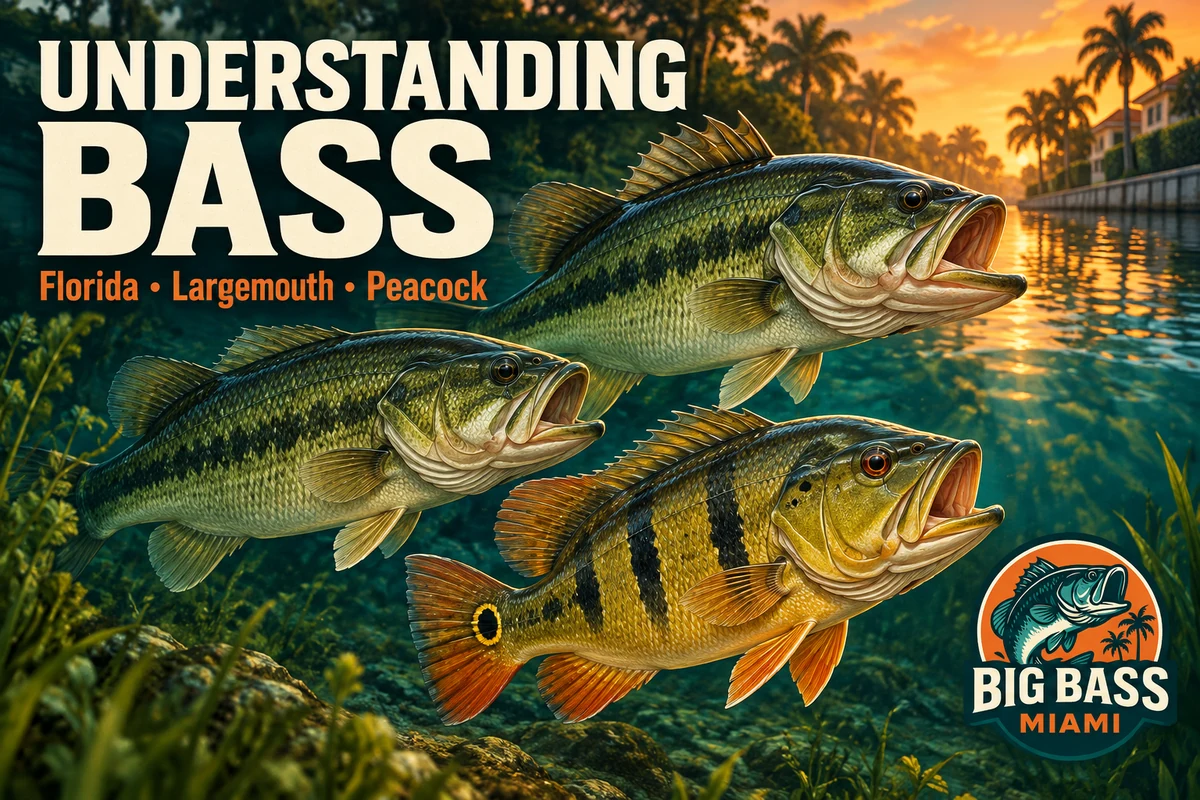
Understanding bass in South Florida starts with three fish: Florida bass, largemouth bass, and butterfly peacock bass. They share a common name, yet they come from two fish families. For example, the familiar green bucketmouth and the bright gold canal fighter look different and call for different approaches.
Three Names, Two Different Families
Florida bass and largemouth bass are closely related black bass in the sunfish family. By contrast, butterfly peacock bass belong to the cichlid family. That’s why a shared name tells you little about how closely the three species are related.
FWC recognizes Florida bass as Micropterus salmoides and largemouth bass as Micropterus nigricans. However, older references use different names, which explains much of the confusion. Meanwhile, the butterfly peacock’s scientific name is Cichla ocellaris.
Florida Bass

A native black bass celebrated for trophy potential. Explore its habitat, the naming change, and its place in Florida fishing.
Meet Florida bass →Largemouth Bass

The classic bucketmouth. Learn the basics and understand how this species differs from Florida bass in current terminology.
Explore largemouth bass →Peacock Bass

A colorful cichlid established in southeast Florida. Discover its distinctive markings, fish-eating habits, and canal habitat.
Discover peacock bass →Explore This Learning Library
Compare the fish, learn which features you can observe, and connect that knowledge to your next trip. Because Florida bass and largemouth bass can be difficult to tell apart visually, use the species guides for more detail.
Understanding Bass Reference
| Topic | What to Know | What to Look For | Why It Matters When Fishing |
|---|---|---|---|
| Bass Species | Florida bass and largemouth bass are closely related black bass in the sunfish family. Butterfly peacock bass belong to the cichlid family. | Compare body shape, mouth, and markings. For example, peacock bass usually show vertical bars and a tail spot. In contrast, Florida bass and largemouth bass look much more alike. | First, identify your target. Then choose a presentation that suits how it feeds and responds to conditions. |
Florida Bass Tap to enlarge ↗ | Florida’s native trophy black bass is called Micropterus salmoides under current FWC terminology. However, older sources often use Micropterus floridanus. | For example, look for the familiar bucketmouth profile and dark markings along the side. Even so, these features alone cannot reliably separate Florida bass from largemouth bass. | Explore vegetation edges, cover, and nearby depth changes. Then adjust lure depth and retrieve speed based on the activity you see. |
Largemouth Bass Tap to enlarge ↗ | FWC now uses Micropterus nigricans for largemouth bass. However, older books may use Micropterus salmoides, the name now used for Florida bass. | Its large mouth and greenish body resemble Florida bass. As a result, size, color, and a photograph alone may not settle the identification. | Therefore, use current species references when labeling catches. For fishing decisions, pay attention to cover, water clarity, depth, and fish response instead of relying on the name alone. |
Butterfly Peacock Bass Reference
| Topic | What to Know | What to Look For | Why It Matters When Fishing |
|---|---|---|---|
Peacock Bass Tap to enlarge ↗ | Miami’s butterfly peacock bass, Cichla ocellaris, is a tropical cichlid introduced by FWC. In general, it feeds mainly on fish and does so during daylight. | Look for a golden body, often with three dark vertical bars, and a dark tail spot surrounded by a yellow-gold halo. However, body color and bars can vary. | For instance, on a daylight trip, try fish-shaped lures with controlled, lively retrieves. After a cold front, account for peacock bass sensitivity to cooler water. |
Can You Identify Them by Appearance?
Butterfly peacocks have a distinctive combination of gold coloration, vertical markings, and a tail eyespot. By comparison, Florida bass and largemouth bass are much harder to separate visually. Their shared green coloration, dark side markings, and broad mouths are not a reliable species test. For that reason, use illustrations and casual photos to learn the markings and consult a species guide when the identification is uncertain.
Learn the Fish, Then Learn the Water
Once you know the fish, learn where it lives. Explore Bass Environments to understand canals, lakes, vegetation, shade, depth changes, and the cover bass use. Next, look for prey activity and choose a presentation you can fish well from a safe access point. Use the habitat as a starting point, then let what you observe guide your next cast.
Respect the Fish and the Water
Before you cast, plan where you’ll land and release the fish. Once you land it, keep handling brief and support it appropriately. Finally, take discarded line and litter home. Explore the Bass Philosophy for the principles behind Big Bass Miami. Before fishing, check FWC’s current freshwater regulations and any rules specific to the water you visit.
Reference: FWC’s species naming explanation and butterfly peacock profile.
Related Lessons from the Journal
Explore stories and lessons connected to this subject.
-

Still Chasing My First 10-Pound Bass
A childhood bass caught beside Tamiami Trail still fuels Peter Cardenas’s pursuit of his first 10-pounder, more than 40 years later on the same…
-

My First Bass: The Bass Buster That Hooked Me for Life
My first largemouth came from a Miami Springs canal on a green Bass Buster Chummin’ Minnow. Its unforgettable Flavorol scent still brings back the…
-

Welcome to Big Bass Miami
Meet Peter Cardenas and discover the stories, fishing lessons, and respect for Florida’s waters behind Big Bass Miami.