
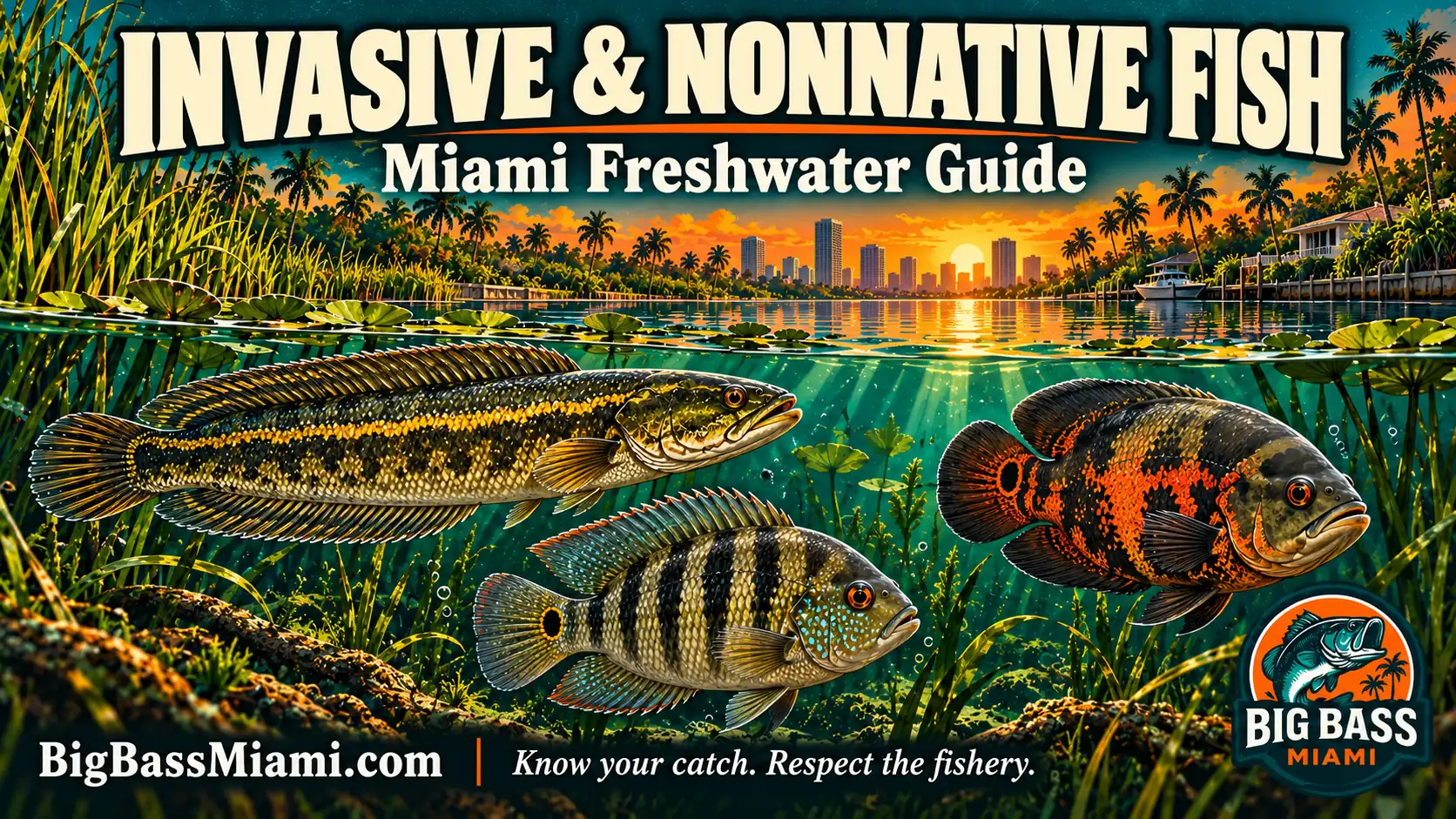
The featured artwork and species images are illustrations. Select a species image to enlarge it.
This guide to invasive fish in Miami also covers other nonnative freshwater species, with identification tips and illustrations. A day on a Miami canal can introduce you to fish from far beyond Florida. Colorful cichlids, tilapia, and snakeheads have become part of the region's freshwater fishing story. Some are widespread. Others occur in particular systems or turn up as unusual encounters.
Nonnative means a fish occurs outside its natural range through introduction. Invasive refers to nonnative species that cause, or are likely to cause, harm. Those terms don't automatically mean the same thing, and a fish's biological status is separate from its legal classification.
This guide covers ten fish entries, with pacu and silver arowana treated as unusual reported encounters rather than common established fisheries.
Mayan Cichlid

Sometimes called the atomic sunfish, this nonnative cichlid has dark vertical bars and a tail eyespot surrounded by a turquoise ring. Its appearance can change with condition and breeding color.
Mayan cichlids occupy many South Florida canals, lakes, and marshes. Small jigs, worms, and shrimp can interest them. Their willingness to take small presentations makes them a possible catch while fishing light tackle for panfish.
Source: FWC Mayan cichlid profile.
Oscar

Oscars have deep, stout bodies and a conspicuous eyespot near the upper base of the tail. Color varies, so compare body shape and markings instead of identifying every dark cichlid as an oscar.
FWC describes strong populations in marsh-related canals, including western Miami-Dade and Everglades habitats. Worms, crickets, cut shrimp, small jigs, and small spinnerbaits are options. Oscars can provide an energetic light-tackle alternative during a bass outing.
Source: FWC oscar profile.
Midas Cichlid

An orange fish in a Miami canal might be a Midas cichlid. Adults can also be red, white, gray, or mottled, so bright orange isn't a requirement. Some develop a noticeable forehead hump.
FWC documents this nonnative fish in Miami-Dade's Black Creek and Cutler Drain systems. For a light-tackle approach, a small jighead tipped with worm is an option. Identification matters: a striking color alone doesn't establish the species.
Sources: FWC Midas profile and FWC nonnative fishing bulletin.
Jaguar Guapote (Jaguar Cichlid)

Dark spots and blotches create the jaguar-like pattern that gives this fish its familiar name. Its toothed mouth and interrupted lateral line help separate it from a similarly patterned native fish such as black crappie.
Jaguar guapote occur in southeast Florida canal systems, with documented Miami-Dade catches. Small artificial lures, including Beetle Spins, and worms can catch them. Treat the mouth carefully when removing a hook.
Source: FWC jaguar guapote profile.
Spotted Tilapia

Spotted tilapia have a deep body with a line of dark bars or spots along the side. Younger fish tend to show bars; larger fish often show more distinct spots.
They have a long history in Miami-Dade canals and also use ponds and lakes. FWC notes that cane-pole anglers catch them, though they can be less aggressive than native sunfish. A fish you can see isn't always a fish that will chase a bass lure.
Source: FWC spotted tilapia profile.
Blue Tilapia

Blue tilapia are nonnative fish that FWC identifies as invasive. Adults often show blue-gray coloring and pink or reddish edges on the dorsal and tail fins. Other tilapia and hybrids can complicate identification.
They occur in South Florida, including Everglades habitats. For this guide, identification comes first: don't assume every large tilapia is the same species or that a visible fish will respond like a predatory cichlid.
Sources: FWC blue tilapia profile and Everglades introduced fishes.
Black Acara

Black acara are small, stocky cichlids with a dark blotch around the middle of the body and another near the tail base. Their subdued coloring makes them easier to overlook than a bright Midas cichlid.
FWC lists black acara as invasive and associates them especially with shallow, disturbed habitats. They are less frequent in larger lakes and canals. Their small size calls for a small presentation if encountered while exploring a light-tackle fishery.
Source: FWC black acara profile.
Snakehead (Goldline / Commonly Called Bullseye)

Florida anglers commonly use the name bullseye snakehead. USGS now identifies Florida's established population as goldline snakehead and documents its expansion into Miami-Dade through the canal system.
These invasive predators have elongated bodies and long dorsal and anal fins. The long anal fin is especially useful when comparing them with native bowfin, also called mudfish. Bowfin have a much shorter anal fin.
Photograph identifying features clearly. Don't rely only on a tail spot or dark body color. A correct identification should come before any decision about the catch.
Sources: USGS Florida snakehead range and identification update and USGS species profile.
Pacu — Unusual Nonnative Encounter

Pacu are South American fish sometimes mistaken for piranhas. The name covers several species; red-bellied pacu (Piaractus brachypomus) are one documented example in Miami-Dade. Their crushing teeth differ from the sharp, serrated teeth of piranhas, but identification should use several features. Keep fingers away from the mouth.
USGS records a red-bellied pacu caught in a Miami-Dade retention pond in August 2022, with aquarium release listed as the potential introduction pathway. Treat pacu as an unusual nonnative encounter rather than a dependable local fishery. A recorded catch does not prove a self-sustaining population; USGS reports no documented successful reproduction for red-bellied pacu in U.S. waters.
If you encounter a suspected pacu, take clear photographs and record the date and location. Those details can help specialists confirm the identification and support a nonnative sighting report to FWC.
Sources: USGS red-bellied pacu profile and USGS Miami-Dade occurrence record.
Silver Arowana — Rare Reported Encounter

Silver arowana belong in a different part of this story. They are South American freshwater fish with long, silvery bodies, large scales, and upward-facing mouths. Miami-area catches have been reported, but those reports do not demonstrate a widespread, self-sustaining local population.
Treat arowana as an unusual nonnative encounter, not a fish readers should expect in an average canal. A clear photograph and reliable location record would be more useful than a promise of a dependable fishing spot.
Sources: Smithsonian silver arowana profile and angler-reported catches. Local occurrence here rests on angler reports, not confirmation of an established Miami population.
Where does peacock bass fit?
Butterfly peacock bass are also nonnative. FWC intentionally introduced them in 1984, and they have their own managed sport fishery. Visit Big Bass Miami’s Peacock Bass page for their history and fishing information. Their example is another reason to avoid treating every nonnative fish as having identical status or rules.
Source: FWC butterfly peacock profile.
Know your catch before deciding what to do
Native bowfin and invasive snakeheads can look similar at first glance. Compare the fins and other identifying features. Don't make a harvest decision from a nickname alone.
FWC's guidance generally encourages harvest of most nonnative fish, with exceptions including butterfly peacock bass. Live possession, transport, and release restrictions differ among species. Consult FWC's nonnative aquatic rules and freshwater regulations for the fish and waterbody involved. Never move fish between waterways.
Recognizing a fish is part of respecting the fishery. Share your unusual catches through the Big Bass Miami Contact page, and help our community learn what's swimming in our local waters.
Tight Lines and Good Times!