

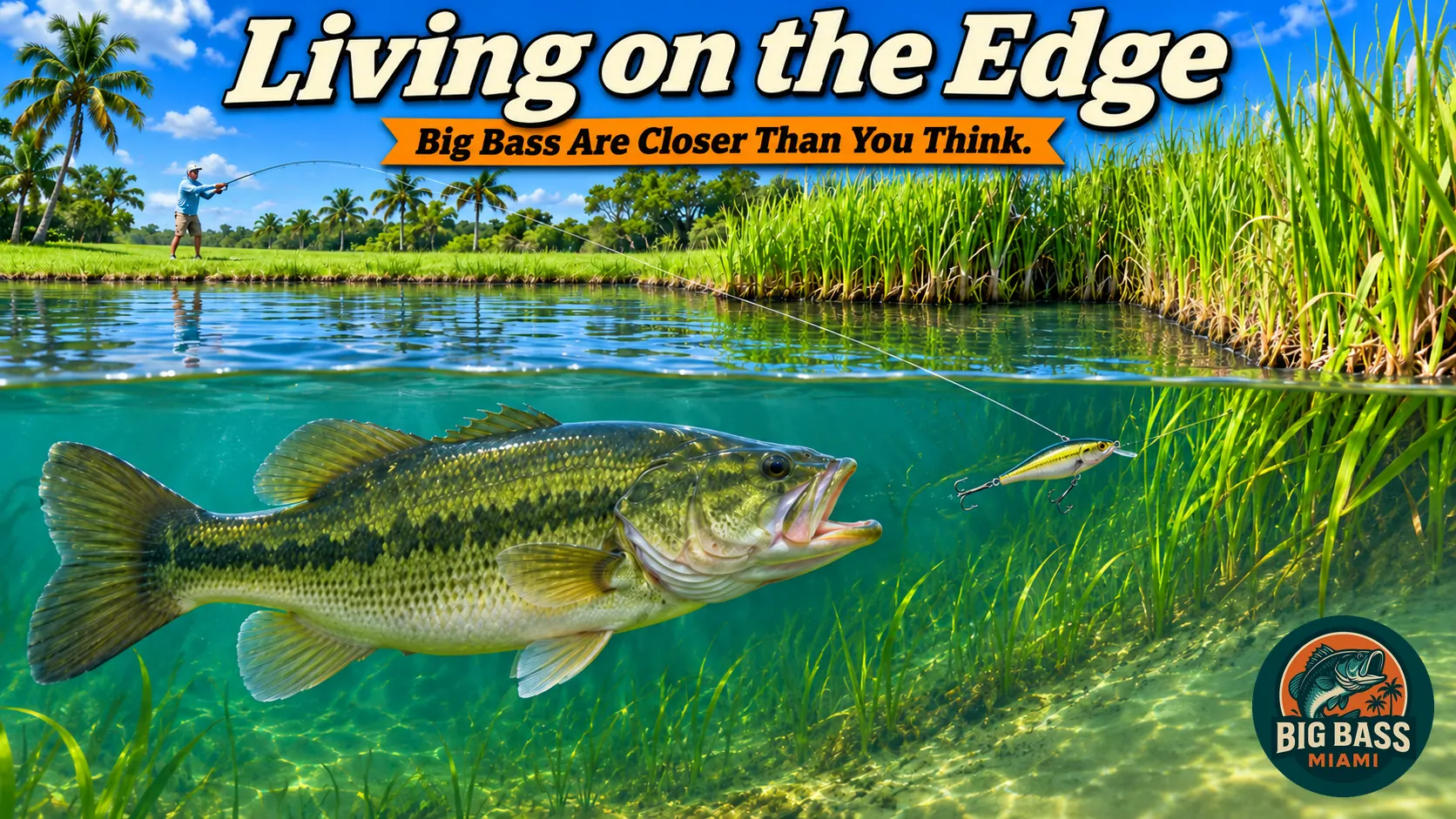
Featured artwork is an illustration inspired by the story.
By Peter Cardenas | Big Bass Miami
Sometimes the water worth fishing sits almost at your feet. That is one of the things I love about bank bass fishing in South Florida.
One spot I fish has a grassy shoreline beside a bridge. From the bank, it might look like an ordinary stretch of water. But about a foot or two out, the bottom drops sharply. I estimate it falls several feet, possibly more than 10 feet in places. I haven’t measured the depth, so that part remains an estimate.
That sudden change is what catches my attention. Before I think about making a long cast, I want to know what might be using that edge.
But a drop-off is only one kind of edge. Grass lines, shoreline corners, little pockets, trees, and bridge shade can all give me something worth casting toward. The trick is to notice what changes along the bank—and give those changes a chance.
An edge is more than the shoreline
When I talk about fishing an edge, I’m looking at more than where the land meets the water.
An edge can be where shallow water drops into deeper water, where thick grass meets an opening, or where a shaded stretch meets sunlight. Sometimes several of those features come together in one small area.
Learning these bass environments gives me a place to start. It doesn’t guarantee a fish, but it gives each cast a purpose.
I want to know what is different about that particular stretch. Is there a change in depth? A break in the grass? A corner? Something providing shade or cover?

Gradual slopes and sudden drop-offs
Some banks ease into the water. There may be a shallow shelf before the bottom gradually slopes away. At those spots, I would explore the nearby shallows, any vegetation, and the water farther out.
Other banks drop almost immediately. A short cast can reach a substantial depth change without going anywhere near the middle.
A drop-off is a change in the shape of the bottom. Grass, roots, branches, or other objects around it provide cover. Put both together, and there are several things to investigate.
At a spot like the one beside my bridge, I would check the shallow lip, the slope, and the water beyond it rather than assume every fish sits at the deepest point.
High banks and low banks
The height of the bank and the depth of the water are two different things.
An elevated bank may put the water several feet below where I stand. That affects casting, retrieving, and landing a fish, but it doesn’t automatically tell me how deep the water is.
A low, level shoreline puts the water close to my feet. It may slope gradually—or hide an immediate drop-off.
Before fishing either one, I want stable footing and a workable landing plan. I won’t step onto an unstable lip or climb down an unsafe bank to reach a fish.
Low banks also call for awareness of alligators. Keep your distance if you see one, never feed one, and don’t treat easy access to the water as a reason to crowd the shoreline.

Corners and bends: give the turn a cast
A straight edge gets my attention. A corner along that edge makes me look twice.
It might be a canal turning, a grassy point sticking out, or a shoreline changing direction. Instead of one continuous bank, there are now two edges meeting.
I would work the stretch approaching the corner, the turn itself, and the water just beyond it. Different casting angles help me bring the lure past that junction rather than simply dropping it somewhere nearby.
An outside corner and a small indentation won’t fish exactly alike. I want to see how the vegetation, depth, and available casting room fit together.
The corner is a target worth checking—not a promise that a bass is waiting there.

Grass pockets and little inlets
When I’m fishing from an accessible bank, I also study the grass on the opposite side.
I look for pockets, little openings, and narrow inlets where the water reaches back into the vegetation. I always give those a cast. Each opening creates another small corner to investigate, and there’s a chance of a bite there.
There doesn’t have to be a big opening to make it interesting. A small break in an otherwise solid grass line gives me something different to work.
I’d check:
- The mouth of the pocket.
- Both grassy sides of the opening.
- The small corners where the opening meets the main grass line.
- The water farther inside, where I can make a clean cast and retrieve.
I also think about getting the lure—and a hooked fish—back out. An opening can look inviting while still being surrounded by thick vegetation.
From the opposite bank, casting accuracy matters. I want the bait close to the feature without throwing it so far into the grass that I cannot work it.

Vegetation edges and openings
A continuous line of reeds, lily pads, or submerged grass can provide a route to follow with a lure.
Rather than cast once into the general area, I would work along the boundary and look for changes: a thin patch, a projecting clump, an opening, or the place where the vegetation ends.
A cast roughly parallel to that edge can keep the lure beside it longer. An angled cast can help me explore the transition between vegetation and open water.
Visible grass doesn’t tell me everything about the bottom. I still pay attention to how the lure falls, where it touches vegetation, and whether the depth changes.

Trees, roots, and fallen timber
Trees add another kind of edge.
Overhanging branches may shade the water. Exposed roots and fallen wood can create cover along the shoreline. A branch extending into the water can interrupt an otherwise ordinary bank.
I would check the outside of the cover first, then work closer where the casting angle allows it. There is no benefit in burying the first cast in branches and disturbing the whole spot while trying to free the lure.
Look above as well as below. Low branches can interfere with the cast, and roots underfoot can make an awkward place to stand.
Bridges: look beyond the obvious
At my spot, the nearby bridge adds another question: does its shade overlap the edge?
I would also look at the pilings, the supports where the bridge meets the bank, and any visible changes around them. A shade line crossing a drop-off or grass edge gives me more than one feature to investigate.
I wouldn’t assume there is current or submerged cover simply because a bridge is present. Those are details to observe.
Where moving water is actually present, I’d watch how it travels around the supports and where the lure can be worked under control. Where the water is still, shade, depth, and cover may be the more useful things to examine.
Fish only from permitted, secure access. Watch for traffic, boats, overhead obstructions, and other people before casting.
Seawalls, rocks, and changes along the bank
An edge doesn’t have to be grassy.
A seawall, rocky shoreline, or transition from a hard bank to vegetation can also give me a defined feature to follow.
I pay particular attention to where something changes: a wall ends, rocks meet grass, or an opening interrupts the shoreline. Those places help me choose a target instead of casting at an entire bank without a plan.
As with other edges, I would explore different angles and depths. The visible shoreline is only part of the picture.

Give the plastic a chance to fall
A plastic worm is a sensible starting point around an edge. Where vegetation makes an exposed hook troublesome, a Texas rig gives me an option to work through it with fewer snags.
I cast into an open pocket among the grass or lily pads and give the worm time to fall through the opening. A bass may pick it up on that initial fall, before I have moved the bait at all. I watch the line for an unexpected twitch, sideways movement, or a stop before the bait should have reached bottom, while keeping enough contact to recognize a bite. Then I take up slack and set the hook when I detect the fish. The goal is to let the bait descend, pause, and move deliberately instead of rushing it back to shore.
I’d adjust the weight to the conditions and the contact I need. A lure that hangs in the grass calls for a different adjustment than one that sweeps away before I can feel it.
Feeling the difference between a fish and grass is something I’ve worked on over more than 40 years of fishing. Even then, attention matters. Watch the line during the fall as well as feeling through the rod. An unexpected movement deserves a closer look.

Make the Cast Count—Especially in the Wind
Casting accuracy is one of the most important skills in the way I fish for bass. Finding a promising edge is only the beginning. I still have to put the bait where I want it—and leave enough room to work it back.
That can mean casting to my left or right along the bank instead of straight ahead. Before I cast, I look at the whole path: the space for the rod and backswing, where the lure should land, where the line will settle, and the route back to me. A good target is not much use if a branch catches the line or the bait lands on the bank.
I want the lure close enough to investigate the cover without burying it in grass or timber. An awkward splash may disturb a fish. A cast too far from the feature may miss the water I intended to fish. One that catches the edge can stop the bait from falling naturally or leave me pulling vegetation instead of working the lure.
Wind makes that judgment more important. It can push the lure during the cast and bow the line after the bait lands, pulling the presentation away from its intended path. I account for that drift, use a controlled trajectory where clearance allows, and take up excess slack without dragging the bait out of position.
Sometimes the best adjustment is a shorter cast or a different position on stable, permitted ground. I do not force a long cast across the wind just to reach a spot. Nor do I move onto an unsafe lip to improve the angle.
Practice placing casts to both sides, choosing the casting motion that fits the available space. The goal is a controlled landing with a clear retrieve—not simply distance. An imperfect cast does not always ruin the opportunity, but a well-placed one gives the bait a better chance to move as intended.

Start close, then work outward
When I say start close to the edge, I mean fish the water nearest the shoreline first. From a secure position back from the bank, I cast to the farthest promising stretch of that edge that I can reach accurately, then bring the lure back through the target water.
I make about three or four casts on one side. The first follows the edge; the next lands a little farther away from the bank, and the following casts work progressively farther out. That fan of casts lets me cover the shoreline, the transition beside it, and the water beyond without skipping straight to the middle.
If I see bait moving, a wake, a follow-up, or other fish activity toward the middle, I give that water a cast too. The pattern helps me cover an area, but I still pay attention to what is happening in front of me.
Once I have worked that stretch, I walk along the accessible bank roughly the distance of a cast, where the footing and access allow, and repeat the process over fresh water. I want to cover as much useful water as I can without repeatedly working the same small patch.
My casts are quick and efficient, but controlled. I keep my retrieves consistent enough to judge the presentation, giving a soft plastic time to fall where needed. Quick casting does not mean rushing the bait back or sacrificing accuracy.
If there are no bites, follows, wakes, or other signs of activity after I cover the stretch, I move on. If a fish shows interest, I slow down and work that area more carefully. No visible movement does not prove there are no fish—it helps me decide where to spend my time.

Plan Your Cast—Protect Your Lure
A promising edge can be expensive if I put the bait in the wrong place. Before casting around grass, lily pads, or trees, I check where the lure will land, where the line will settle, and how I will retrieve it. A clear landing spot does not help much if a branch catches the line or the bait has to come back through a solid wall of vegetation.
I learned that lesson with a brand-new frog I had just bought. I decided to try it in a grassy area full of lily pads. On the very first cast, it got stuck, and I lost it. That was a ten-dollar frog, gone on its first cast. I wanted to see what it could do, but I never got the chance.
Around snag-prone cover, I often choose a soft plastic rigged with the hook point concealed. It can help me work through vegetation with fewer hang-ups, although no rig is snag-proof. Losing a worm is easier on the wallet than losing a $10 frog or a $15 jerkbait. That does not mean those lures cannot work around cover; it means I choose the bait and casting angle with the risk in mind.
If I get snagged, I stay on stable ground. I do not lean over the canal, climb onto branches, or step onto a loose bank to save the bait. I also avoid pulling a hooked lure hard toward myself, since it can spring back when it comes free. If freeing it means risking a fall into the water, I leave it behind. There may be an alligator nearby that I have not seen. No $15 lure is worth my life.

Walk the edge with your footing in mind
When I walk along the edge, I have to watch where I am going—not just the water. It is easy to follow a wake, study a grass pocket, or look for the next fish while my feet keep moving. That is how a hole hidden in the grass, an exposed root, or a tree stump can catch me by surprise.
Before each move, I look along the path for holes, roots, stumps, loose soil, slippery grass, and sudden changes in the bank. I choose stable, permitted ground and leave room between myself and the water. If I want a closer look at something in the canal, I stop walking first, get my footing, and then look.
I also stay alert for snakes, spiders, and other critters that could bite or sting. Tall grass, roots, fallen logs, and rocks can hide more than a tripping hazard. I watch where I step and where I put my hands, avoid reaching into places I cannot see, and give any wildlife room. Staying vigilant is part of walking the edge safely.
A trip beside a canal can put me straight into the water. In South Florida, there may also be an alligator nearby that I have not noticed. I do not want to discover that danger after losing my balance. Watching my step and staying aware of the surrounding water matter more than following a fish or reaching the next casting spot.
Covering more water only helps if I can do it safely. I take the time to check my next steps, and I leave a stretch alone if there is no secure way to walk it. Keep your eyes on the path while moving; stop to study the water.

Keep the Water in Sight
When I’m walking, I watch where I put my feet. If I want to study the water, I stop on stable ground first. The same goes when I land a bass. That’s when it’s easiest to get caught up in the fish and turn my back on the canal.
If you’re right at the water’s edge, keep the water in view. Before I unhook a fish or pose for a photo, I check the ground and move to a stable spot well back from the bank. I keep the shoreline in sight while I handle the fish. If an alligator approaches, I give it room and leave the area. If it takes the fish, I let it go.
On an Everglades canal one night, my headlamp picked up the reflection of a single eye on my side of the bank. It felt like that gator had been waiting for me. I tell the full story in Eyes Along the Edge.
For me, that grassy bank beside the bridge is a reminder to slow down and look closely. The next useful feature might be a drop-off almost at my feet—or a little pocket in the grass across the canal.
Before casting past the edge, give it a chance.
Tight Lines and Good Times!
—Peter Cardenas
Do You Have a Story to Tell?
We’d love to hear your fishing story. Share it with us through the contact form or reach out to Big Bass Miami on social media.