
See Florida & World Records resources →
Prepare before the fish of a lifetime bites. A plan for weighing, identification and documentation gives a potential record catch its best chance of being properly reviewed.
1. Decide which record you are preparing for

A huge fish is exciting. Turning that catch into a record claim takes preparation. Choose your record program before the trip, then keep its current instructions with your gear.
| Goal | Where to begin |
|---|---|
| Florida freshwater state record | FWC’s eligible species, current record and certification process. |
| IGFA All-Tackle weight record | The species entry and weight-record requirements. |
| IGFA line-class or fly-tippet record | The specific category, tackle restrictions and tested line strength. |
| IGFA catch-and-release length record | Eligible species and the official measuring-device rules. |
Tarpon, snook and jack crevalle need their own species and program checks, even when encountered in fresh water. Their Florida state-record route is the marine records program. This guide focuses on freshwater preparation; use the applicable authority’s instructions for your catch.
2. Understand the line and tackle requirements

You do not universally need a special brand of “record line.” IGFA permits several line types; line-class eligibility depends on tested breaking strength, not just the number printed on the spool. Check your entire rig against the chosen category, including leaders, hooks and permitted assistance.
Keep the line packaging and note the setup before fishing. For a conventional IGFA weight claim, preserve the required connected leader, double line if used, and at least 5 meters (16.5 feet) of the adjoining line. Follow the application’s instructions for hooks or lures. Fly claims have different sample requirements. Do not dismantle or discard evidence before checking.
3. Arrange an accepted scale before the trip

A scale being new or digital does not establish that it meets a record program’s certification requirements. Ask who certified it, when, and whether the record authority accepts that certification. Keep the paperwork and identify a backup weighing location.
FWC: Florida freshwater certification requires an FWC-witnessed weighing on a scale certified by the Florida Department of Agriculture and Consumer Services.
IGFA: its rules call for an accuracy certification within the preceding 12 months, with a procedure for prompt testing if that was not in place. Plan for a current certificate rather than relying on that exception. Deduct any sling or container weight and record the actual reading; estimates do not qualify.
4. Prepare photographs, video and witnesses

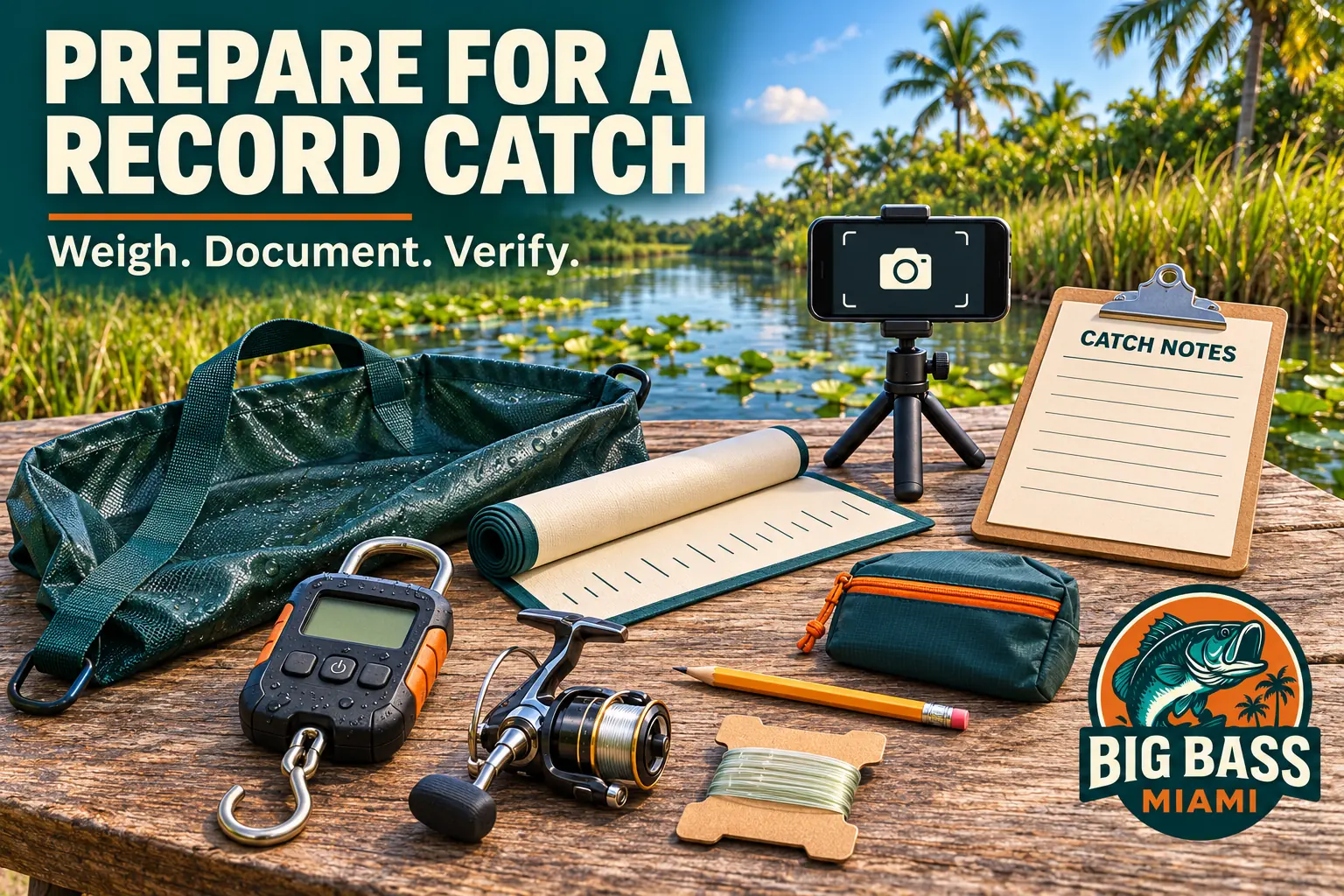
Charge your phone, clear storage and ask a companion to handle documentation while you care for the fish. Put your checklist where it is easy to find.
- Clear full-fish identification photographs, showing distinctive markings and fins.
- The angler with the fish, plus the relevant tackle and weighing equipment.
- The scale reading and measurements, photographed clearly.
- Catch date, time, location, tackle details and witness contact information.
IGFA requires photographs. Video is useful supporting evidence, not an automatic replacement for required still images, forms, witnesses or inspection. Keep original files rather than only social-media copies.
5. Plan for the fish itself

FWC requires physical inspection by a fisheries biologist for species other than the Largemouth Bass category. For that bass category, identification may use photos or video, while an FWC employee must still witness the official weighing. Confirm the arrangement before assuming a photo-and-release catch will qualify.
FWC recommends keeping the fish alive when possible; otherwise use ice water and avoid freezing before weighing. Retention and transport must remain lawful, especially for nonnative fish. Contact FWC promptly for directions.
IGFA may need expert examination or a retained specimen when identification remains uncertain. Ask about that before release, cleaning or disposal. If pursuing both programs, resolve weighing and preservation instructions with both authorities first.
Prepare a suitable wet landing surface and handling plan so decisions do not become a long photo session. A potential record does not justify keeping a fish unlawfully or ignoring its condition.
6. Choose weight or catch-and-release length

IGFA length claims require an official IGFA measuring device, measurement at the catch site and a healthy release. Fish entered for those length records cannot also be weighed and submitted in other record categories. Decide the route before documenting the catch.
Measurement methods differ between programs. Follow the correct diagram for mouth position and tail measurement instead of treating every ruler photograph as interchangeable.
7. If the next fish looks like a potential record

- Handle it carefully and check which species and category may apply.
- Record an initial reading if appropriate for your chosen route.
- Contact the record authority and arrange the required weighing or inspection.
- Gather the photographs, witness details and tackle evidence.
- Follow lawful handling, retention or release instructions.
Have a companion read your checklist aloud. Work steadily; a dramatic photograph can wait until the essential evidence and fish care are handled.
8. Submit a complete claim
Use current official forms and check signatures, supporting evidence and deadlines. For IGFA categories other than All-Tackle, continental-U.S. claims generally must arrive within 60 days; other waters generally have 90 days. Verify the applicable category’s current rules rather than assuming every claim has the same deadline.
Save copies and submission receipts. Certification is the authority’s decision: call the catch a potential record until it is approved.
9. Before-you-go checklist
- Current species/category rules and official contact details saved offline.
- Accepted scale, certification paperwork and backup weighing plan.
- Appropriate measuring equipment and fish-handling supplies.
- Charged phone, power bank and space for original photos and video.
- Notebook, pencil, current application and witness plan.
- Labeled packaging for any required tackle samples.
Walk through the process at home once. Knowing who will photograph, record and call can make the real moment much easier.
Official instructions and forms
Research checked November 2, 2026. Recheck these sources before a record attempt.
Keep learning: Understanding Bass · Respect the Fish · Sunglasses & Sun Protection