
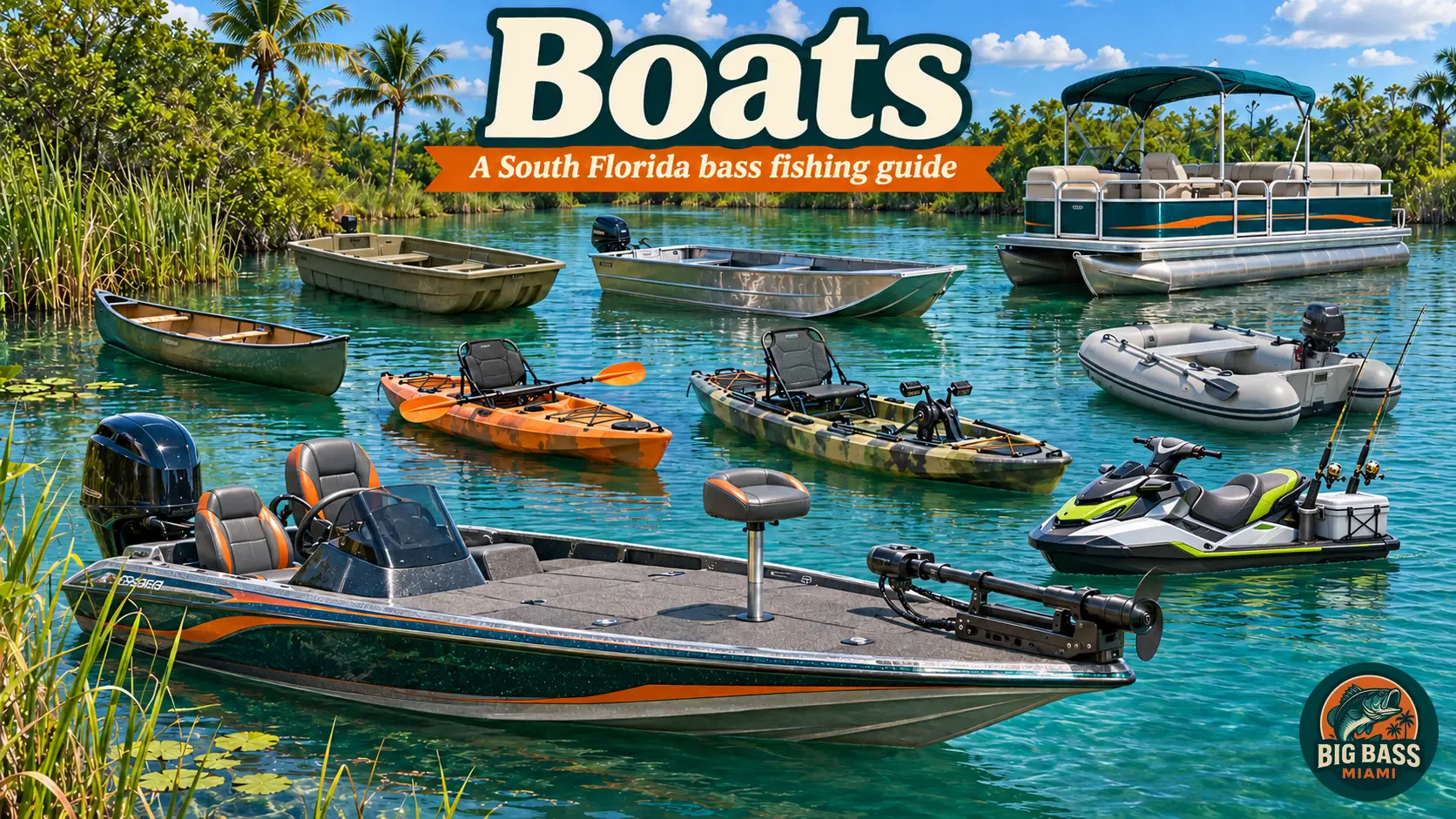
A narrow Miami canal and a wide stretch of open water ask different things of a fishing boat. If you’re carrying your setup down a grassy bank, a canoe or kayak may get you to water you’d pass with a trailer. If you’re crossing a lake or fishing with a partner, deck space, seating, and storage can make the day easier.
Start with where you’ll launch, how far you’ll run, and how you like to fish. Use the comparison below to narrow your choices, then see how tools like trolling motors and shallow-water anchors can help you work an edge or hold your casting position.
Find the Right Boat for the Water You Fish
| Fishing Boat Type | What to Look For |
|---|---|
| Canoes | Carry weight and seating |
| Fishing Kayaks | Launch access and drive clearance |
| Inflatables & Float Tubes | Transport and water conditions |
| Compact Molded Fishing Boats | Loaded weight and deck space |
| Aluminum Fishing Boats | Hull shape and storage |
| Fiberglass Fishing Boats | Draft and casting layout |
| Pontoons | Seating and casting room |
| Jet Skis & Personal Watercraft | Rod-holder placement and compact gear storage |
Canoes

A solo canoe leaves room for a few rods and a small tackle bag. A tandem canoe gives two anglers separate seats and room for shared gear. Picture where each person will cast and how you'll carry the canoe to the launch.
For a short canal trip, compare the canoe’s empty weight with what you can comfortably carry from the parking area. If you usually fish with a partner, check whether both seats leave enough room to cast and land a fish.
On a tandem, lay rods lengthwise between the seats so both anglers have a clear spot to set down a paddle.
Fishing Kayaks

A sit-inside kayak seats you inside the hull. A sit-on-top gives you an open deck for rod holders and a crate. Paddle models keep the setup simple, pedal drives leave your hands free between casts, and motorized models help cover more water. Around shallow shelves or grass, check how easily you can lift the drive clear.
Picture how you’ll fish a grass line. A paddle is easy to set down for a cast, while a pedal drive can help you keep moving between casts. Check where your rods, crate, and landing net will sit before choosing a deck layout.
Check whether you can reach your landing net from the seat without turning around.
Inflatables & Float Tubes

An inflatable fishing boat offers a broader platform, while an inflatable kayak packs down for transport. A float tube puts your legs in the water. Consider alligators, boat wakes, current, wind, and submerged debris when deciding whether a South Florida launch suits the craft.
Think through how you’d get back to the launch if the wind picks up or the current changes. A compact craft can be convenient to transport, but the conditions at the launch and along your route should guide your choice.
Check how much room the packed craft, pump, and gear take up in your vehicle.
Compact Molded Fishing Boats

Small molded plastic and polyethylene boats offer dedicated seats and a compact deck. Compare loaded weight, carrying handles, motor-mount options, and the distance from your vehicle to the water.
Look at the floor and seat layout with your usual gear aboard. A clear spot for your feet and a place to stow a tackle tray can matter more than extra storage you can’t reach while fishing.
Look for flat spots where a tackle tray can sit without sliding into your foot space.
Dedicated bass boats commonly come with either aluminum or fiberglass hulls. Both can have raised casting decks, rod storage, and room for a bow-mounted trolling motor. Compare the layout and loaded weight with how you fish.
Aluminum Fishing Boats

A flat-bottom jon boat gives you an open layout you can outfit yourself. Utility boats come in several layouts, including V-hulls. An aluminum bass boat adds casting decks and dedicated rod and tackle storage. Tracker is one familiar example.
If you like to build your own setup, compare a bare jon boat with a fishing-ready aluminum bass boat. Look at what comes with each package, including the trailer, casting deck, and rod storage.
Compare how easily a long rod fits inside the storage you plan to use.
Fiberglass Fishing Boats

A standard fiberglass bass boat gives you a dedicated casting layout. Premium models may offer larger decks, more storage, or more room for electronics. Nitro is one familiar example. Flats boats emphasize shallow-water access, small center consoles leave room around the helm, and fish-and-ski boats split their space between casting and family outings.
Walk through a typical day in your head. A dedicated bass layout gives you room to work from the bow, while a center console or fish-and-ski may suit trips where passengers want more seating or space to move.
If you fish from the bow, check how a pedestal seat and a trolling motor pedal fit together on the deck.
Pontoons

A personal fishing pontoon gives one angler a compact platform. A full-size pontoon makes room for family and extra gear. Check where you’ll stand to cast and how seats and railings affect your casting angles.
For family fishing, look for a corner where someone can cast without reaching over a seat. If you mostly fish alone, compare how much gear a personal pontoon can carry with how much setup it takes at the launch.
Look for rod holders that keep spare rods clear of seats and walkways.
Jet Skis & Personal Watercraft

A fishing-equipped jet ski gives you another compact way to approach a day of bass fishing. Compare the seating and rear-deck layout with the gear you want to carry. Side-mounted rod holders, a secured cooler, and a small tackle-storage setup can help keep your fishing outfit organized.
Look for accessory mounts designed for the particular watercraft, and check how the rod holders and cooler fit around the seat. Picture where you would place a rod between casts and how easily you could reach your tackle while seated.
Keep the setup manageable. A few rods and a compact selection of tackle may suit the available space better than carrying your full boat collection.
Bass Boat Technology
Find a canal drop-off, stay within casting range, and come back from the same angle.
Fish Finders, GPS & Mapping

Many fish finders combine sonar, GPS, and mapping in one display. Use depth readings and 2D sonar to spot a drop-off beneath you. Down imaging shows more detail below, side imaging scans to either side, and forward-facing sonar looks where you aim the transducer. Save a waypoint on a productive edge and use a recorded track to repeat your pass.
On a first pass, look for where the shelf changes depth or the grass ends. Mark that spot, then make another pass from a different angle to see how the edge runs.
Mark the spot where you got the bite and note the direction of the cast so you can line up the same presentation.
Trolling Motors

A trolling motor helps you work a bank slowly and adjust your position between casts. A hand-controlled transom mount can suit a small jon boat. A bow mount lets you steer from the front casting deck. Compatible models with GPS hold can help you stay near a deeper canal edge.
Think about where you stand or sit while casting. Put the control within reach so you can correct your drift without leaving your fishing position.
On a windy bank, use small speed changes to keep a steady casting distance from the shoreline.
Shallow-Water Anchors

A manual stakeout pole can hold a kayak or small boat when it reaches suitable bottom. A powered system such as a Power-Pole can hold a compatible boat while you make repeated casts to a shallow grass pocket. When the bottom is out of reach, a trolling motor with GPS hold can help you maintain position.
On a shallow flat, set up a cast away from the grass pocket so you can work the opening from several angles. Check the anchor’s reach against the depths you fish most.
Think about whether you want to face the bank or cast along it before setting the anchor.
Keep Exploring Bass Class
Visit Tackle Box for organizing gear on the bank or aboard. Then explore Rods, Reels & Line to put together an outfit, or Techniques & Rigs to plan your next presentation. Before you head out, check the Miami Bass Fishing Report for local conditions.