

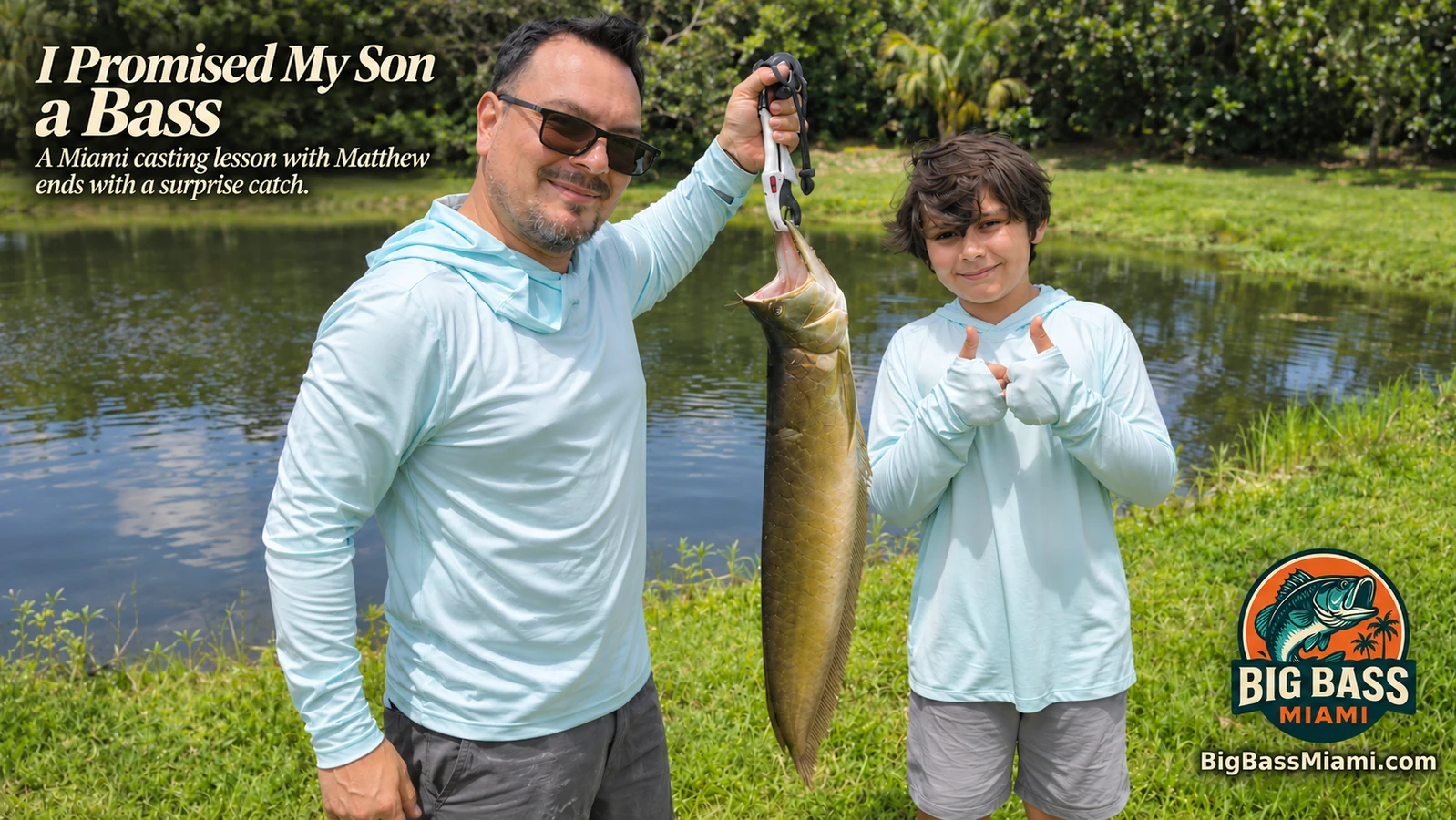
I took my son fishing for bass in Miami. I came home with a story about a silver arowana, a fish I recognized from restaurant aquariums.
By Peter Cardenas | Big Bass Miami
My son Matthew lives in Jacksonville, and he was visiting for the summer. Fishing together sounded like a good way to spend some time. Miami’s summer heat had other plans.
It was extremely hot. I had brought water with ice, but even with cold water, being out there was rough. We were feeling it.
We started fishing some lakes I knew, then headed to a pond I had never actually fished. I didn’t know what we would find there. I certainly wasn’t expecting what happened next.
A target worth hitting
I was helping Matthew with his casting and emphasizing something I talk about often: putting the bait in the right place matters. A promising spot only helps if you can get your lure there and work it through the area.
Then I noticed a gate extending into the water. There was a little area around it that looked especially promising.
I pointed it out to Matthew and told him to cast there. I was sure a big bass was waiting to hit the bait.

His cast sailed too far left. He tried again, but he kept missing the target.
Eventually, I took the rod to demonstrate. I told him I was going to show him how it was done—and catch the fish I thought was sitting there.
That is a confident thing to say when you have no idea what is actually underwater.
That did not feel like a bass
I made the cast. As I brought the bait through the area I had picked out, something hit it.
Immediately, it felt different.
The fish pulled hard and shook its head more than any bass I remembered catching. Then it started jumping.

At first, it reminded me of a tarpon, but the tail looked wrong. From a distance, I couldn’t make sense of it. I was excited, trying to keep it hooked, and wondering what in the world I had caught.
Matthew wanted me to hand him the rod. I was afraid we might lose the fish during the handoff. I wanted to land it and finally see what it was, so I kept the rod and worked it toward the bank.
This casting lesson had taken a turn neither of us expected.
A silver arowana in an unfamiliar place
When it came close enough, I recognized it.
A silver arowana.
I knew that fish from aquariums in Chinese restaurants. Seeing one on the end of my line in a Miami pond was another matter entirely.

It weighed just under seven pounds.
At the time, I had never heard of anyone catching an arowana here in South Florida. That doesn’t mean nobody had done it. It means this was completely new to me—and a catch I wasn’t going to forget.
I posted a video of us holding the silver arowana on TikTok and shared the weight. Soon, other anglers were contacting me to ask where I had caught it.
I wondered whether some wanted to catch it and sell it, although I couldn’t know their intentions. Either way, I kept the location to myself.
A big fish in a small pond. I wanted to keep it that way.
Could silver arowana become the next snakehead?
I haven’t returned to that pond or tried to catch that fish again. But I later saw another arowana in a different pond, miles away.
One arowana was a surprise. Seeing another in a completely different area, miles away, made me wonder what else might be out there. Are people releasing them into our canals, lakes, and ponds? Could they already be breeding? I suspect releases, breeding, or some combination could explain what I saw, but I have no proof of the cause or of local reproduction.
Here is my concern, and I want to put it on record now: arowana could become the next snakehead in South Florida. If people keep releasing them and the fish begin reproducing successfully, we could be looking at another nonnative fish spreading through our waters. That is my prediction as an angler who has seen two in separate places—not a confirmed finding that it is happening.
For more on the fish itself, see the Smithsonian’s species profile.
Still, the possibility of another unfamiliar fish spreading through our waters concerns me. An exciting catch and a healthy fishery aren’t necessarily the same thing.
Would I be excited to hook another one? Absolutely.
But what stays with me most is the day with Matthew. He was visiting for the summer, we were sweating through a Miami fishing trip, and I was trying to teach him to hit a target.
I thought I was about to show him where a big bass lived.
Instead, we both learned to expect a surprise.
Tight Lines and Good Times!
—Peter Cardenas