
One Splash. One Glowing Eye. One Lesson I’ll Never Forget.
There’s something special about walking the edge in the Florida Everglades. One evening, an Everglades alligator encounter changed the way I fish those canal banks after dark.
For more than 40 years, I’ve enjoyed fishing South Florida’s canals, exploring grassy shorelines, and searching for big bass hiding along the drop-offs.
Sometimes I’ll walk a considerable distance, making cast after cast, before finally turning around and fishing my way back.
And sometimes, especially when the fishing is good, I lose track of time.
That’s where this story begins.
Getting a Little Too Comfortable
I’d been fishing the same stretch of canal for three or four days straight.
Every day, I’d walk the edge, working the drop-offs, looking for bass, and enjoying the peaceful surroundings of the Everglades.
I’d walk quite a distance before turning around. And instead of simply walking back, I’d often continue fishing along the way.
The problem was that sometimes darkness would catch me before I reached my starting point.
I remember one evening when I didn’t even have a headlamp. I was using the light from my phone while continuing to fish.
Looking back, that wasn’t one of my smartest decisions.
I knew alligators lived in those waters. I’d been fishing South Florida my entire life. But when you visit the same place over and over without anything happening, it’s easy to become a little too comfortable.
And that’s exactly what I believe was happening to me.

The Splash Across the Canal
One afternoon, while walking that familiar stretch, I heard rustling in the vegetation on the opposite side of the canal.
Then came a splash.
An alligator had entered the water.
The sound came from an area near a bridge, approximately 250 feet away. I wasn’t standing next to the animal or approaching it.
But something about that splash caught my attention.
I’d been fishing this area consistently for several days, and I’d walked that same edge countless times before. Yet I couldn’t remember hearing an alligator enter the water quite like that.
Then a strange thought crossed my mind.
What if that alligator has been watching me?
I started thinking about the previous days. The long walks, the repeated trips, and the times I’d returned after dark.
Had that alligator noticed me coming and going?
Had I become predictable?
Maybe it had seen me walking that edge over and over and recognized that I kept returning along the same route.
I couldn’t shake the feeling that something wasn’t right.
I’ve always believed in guardian angels, and that day, I felt as though mine was putting a warning in my head.
Be careful. That alligator wants you.
I know how that sounds, but that’s exactly how I remember feeling.
And that thought stayed with me.

One More Bass Before Dark
Despite that uneasy feeling, I continued fishing.
I walked farther down the canal, making casts along the edge and searching for another big bass.
And sure enough, I caught a beautiful bass.
That’s one of the things I love about fishing the Everglades. You never know when that next cast will produce something special.
But while I was enjoying the fishing, the sun was going down.
By the time I started heading back, darkness had settled over the canal.
Fortunately, this time I had my headlamp.
The mosquitoes were relentless, the surrounding vegetation was difficult to see, and the familiar shoreline looked very different in the darkness.
As I approached the area where I’d heard that splash earlier, the thought returned.
Where’s that alligator?
Something told me to pay close attention.
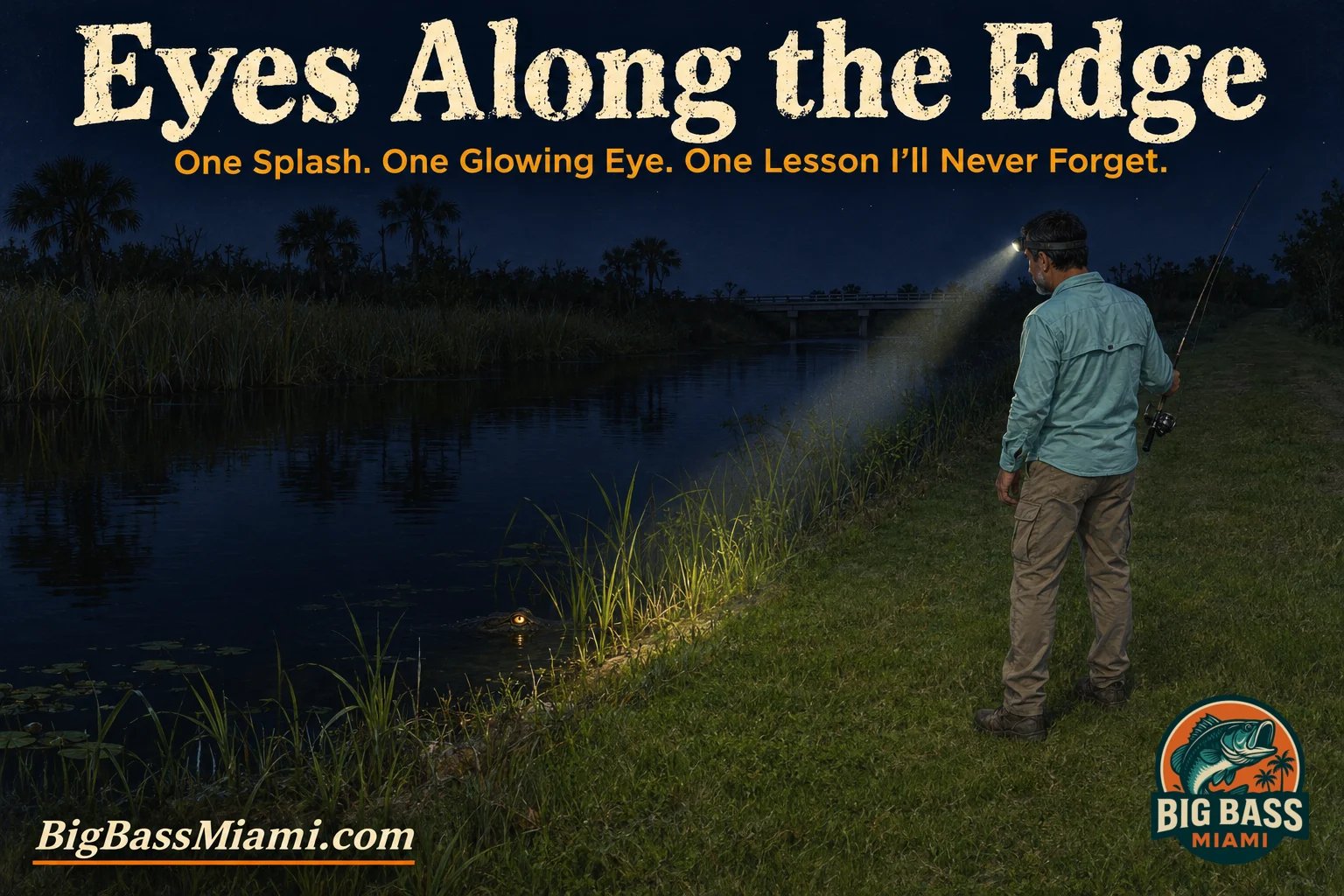
So I started scanning the edge with my headlamp.
And then I saw it.
My Everglades Alligator Encounter
Not two eyes.
Just one.
The beam from my headlamp caught the reflection of a single alligator eye near the water’s edge.
There it was.
A good-sized alligator, at least six feet long, positioned close to the bank on my side of the canal.
Its snout was facing toward the edge, and from where I stood, only one eye reflected my light.
Had it not been for that tiny reflection, I might have walked right past without noticing it.
I couldn’t believe what I was seeing.
And you know what?
I laughed.
Not because the situation was funny or because I wasn’t concerned.
I laughed because I’d been thinking about that alligator ever since I heard the splash.
And now, there it was.
I knew it! There you are!
I wondered whether this was the same alligator I’d heard earlier. In that moment, it felt like it had been watching me. I’d walked that edge repeatedly for several days, sometimes returning after dark, and now I found it positioned near the very bank where I was walking.
I felt as though I’d caught it waiting for me.
Of course, I couldn’t know exactly what the animal intended. But I wasn’t interested in finding out.
What shocked me most was that I’d fished that same stretch so many times and had never seen an alligator positioned along the bank quite like that.
It was a powerful reminder that just because you don’t see danger doesn’t mean it isn’t there.

The Lesson That Changed My Fishing Routine
That encounter changed how I plan a fishing trip along the edge.
Before that night, I’d sometimes keep casting long after sunset, trying to squeeze in a few more minutes of fishing.
Afterward, I began planning my walks much more carefully.
Now, when I head down a long stretch of canal, I pay attention to how far I’ve walked and how much daylight remains.
I give myself enough time to make the return trip before darkness.
And if I do get caught out after sunset?
I stop fishing and concentrate on getting back safely.
No more stopping for one last cast.
No more trying to catch another bass while walking through the darkness.
I keep my light on, watch where I’m going, and make my way back.
Because no matter how well I know a fishing spot, I have to remember that I’m sharing it with wildlife.
Alligators Aren’t the Only Danger
Anyone who has spent time along an Everglades canal after dark knows that alligators aren’t the only concern.
Let’s talk about mosquitoes.
They’re absolutely relentless.
You can be having a wonderful evening fishing, but once those mosquitoes get going, they can make the entire experience miserable.
And then there are the spiders.
The tall grass and vegetation along canal banks provide plenty of places for spiders to build their webs.
At night, those webs can stretch across the grass and pathways where you’re walking.
The last thing I want is to walk face-first into a spiderweb or accidentally disturb a spider I couldn’t see.
Then there’s the terrain itself.
Many South Florida canals have steep drop-offs. Some banks fall several feet into deep water just a foot or two from where you’re standing.
Add darkness, slippery grass, uneven ground, and limited visibility, and one careless step can become a serious problem.
It’s simply not worth the risk.

Never Turn Your Back on the Water
There’s another important lesson I want every angler to remember.
Never become so distracted by a fish that you forget what’s happening behind you.
It’s easy to get excited when you catch a big bass.
You land the fish, admire it, take a photograph, and concentrate on removing the hook.
But if you’re standing right at the water’s edge, you’re putting yourself in a vulnerable position.
When you land a fish, check your footing and move to a stable spot well back from the shoreline. Keep the water in view while you unhook the fish or take a photo. If an alligator approaches, give it room and leave the area. Never try to take a fish back from it.
For more on footing and fishing from the bank, see Living on the Edge. The Florida Fish and Wildlife Conservation Commission also provides guidance on living around alligators.
No bass is worth losing your life over.
My Advice to Anyone Fishing the Edge
If you’re planning to fish South Florida’s canals, lakes, or the Everglades, here are a few things I’ve learned:
- Plan your return before sunset. Remember that you still have to walk back. Give yourself extra time.
- Bring a fishing partner. Fish with someone who can keep an eye on the shoreline while you land a fish and call for help if there’s an emergency.
- Carry a reliable headlamp. Even if you plan to return during daylight, be prepared for unexpected delays.
- Never assume a familiar location is completely safe. Wildlife can be present even when you don’t see it.
- Stay alert around alligators. Keep your distance, watch the shoreline, and never approach or provoke them.
- Carry a personal-defense tool where it’s permitted. Choose something you know how to handle safely. If an alligator approaches, give it room and leave the area.
- If an alligator attacks, fight back. If you can’t get away and the fishing rod is already in your hands, use it to defend yourself as a last resort while you try to break free. The U.S. Fish and Wildlife Service advises fighting back if bitten.
- Don’t turn your back on the water while handling fish. Step away from the shoreline and maintain awareness.
- Watch your footing. Steep drop-offs, slippery banks, and hidden obstacles are especially dangerous at night.
- Prepare for mosquitoes and spiders. Insects and webs can make nighttime walking unpleasant and distracting.
- Let someone know where you’re going. This is particularly important when fishing remote areas alone.
- Know when to call it a day. There will always be another opportunity to catch a bass.
Respect the Wild
I still think about that encounter.
The rustling across the canal.
The splash.
The strange feeling that something was watching me.
And finally, that one glowing eye reflecting my headlamp.
I’ll never know for certain what that alligator was thinking.
But I know what I was thinking.
That gator was waiting for me.
Maybe my guardian angel was looking out for me that evening. I certainly believe I was given a warning, and I’m grateful I paid attention.
The experience reminded me that even after more than 40 years of fishing South Florida’s waters, there’s always something new to learn.
The Everglades are beautiful, but they’re also wild.
We are visitors in an environment shared with powerful animals, and we need to respect that.
Today, when I’m walking the edge and the sun begins to disappear, I know it’s time to start heading back.
There will always be another day to fish.
And I’d rather be around to enjoy it.
Respect the Water. Respect the Wildlife. Respect Your Life.
Tight Lines and Good Times!
—Peter Cardenas
Big Bass Miami — Where the Big Bass Live.
Do You Have a Story to Tell?
We’d love to hear your fishing story. Share it with us through the contact form or reach out to Big Bass Miami on social media.