

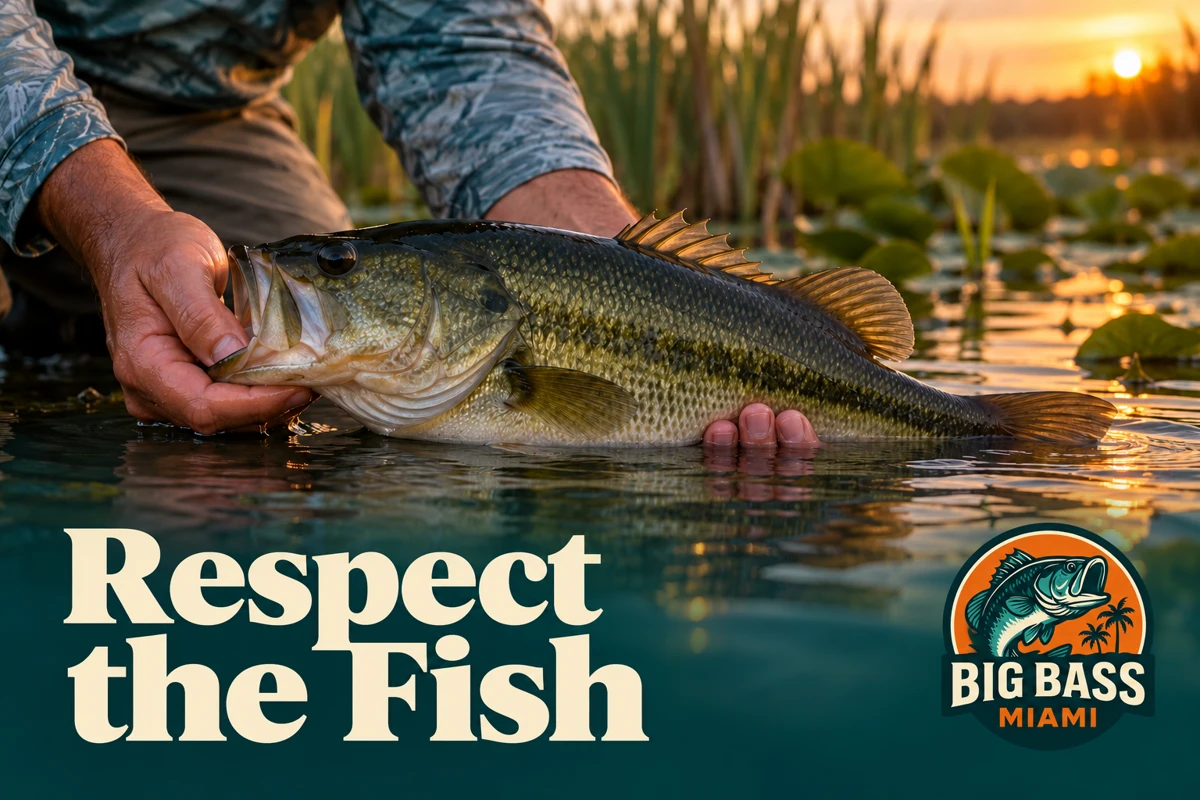
A big bass can make your hands shake. You finally have the fish you hoped for, and you want to take it all in.
Enjoy that moment. Just remember that the fish needs care while you do.
The way we handle a catch matters whether it’s a trophy or the smallest bass of the morning.
Get Your Fishing License. Support the Fishery.
A Florida freshwater fishing license is generally required to fish for bass—even when you release every catch—unless an exemption applies. License fees support fisheries management and help fund conservation work, including habitat restoration and fish stocking through Florida’s fisheries and Sport Fish Restoration programs.
Visitors from another Florida town follow Florida residency rules; being “from out of town” does not automatically make you a nonresident. Out-of-state visitors age 16 and older generally need a Florida license. Another state’s fishing license is not valid here. Exemptions include children under 16 and qualifying Florida residents age 65 or older; the resident senior exemption does not extend to visiting nonresident seniors.
Do Visitors Have to Buy a Full Year?
No. FWC still lists nonresident freshwater licenses for 3 days ($17), 7 days ($30), and one year ($47), before applicable additional fees. Effective November 7, 2025, nonresident 3-day and 7-day recreational fishing licenses are sold only in person at participating license agents or tax collectors’ offices—not online or by phone. An annual license remains an online option.
FWC visitor requirements · Freshwater license options and fees · Where to buy a license · Check exemptions · How fishing supports conservation
Better Habits Start with the Next Catch
Many of us learned to fish before we learned much about fish care. We may have kept a bass out too long, placed it on dry grass, or concentrated more on the photograph than the fish.
Even today, I’m still improving some of these habits. The Bass Philosophy gives us a reason to keep learning together.
Simple, inexpensive changes can help: accessible pliers and cutters, a ready camera, and a plan for landing and releasing the fish safely.
Protect the Slime Coat
The slippery coating on a bass is protective mucus, often called its slime coat. It helps defend the fish against infection.
Dry hands, towels, grass, pavement, and rough surfaces can remove that protection. Avoid laying a bass on the ground or a hot boat deck.
Some people dislike touching a slippery fish and reach for a towel. Skip the dry towel. Use clean, wet hands and keep contact gentle and brief.
Support the Fish Without Damaging Its Jaw
If briefly holding a bass by its lower jaw, keep it upright and avoid bending the jaw backward.
Don’t tilt it horizontally by the mouth alone. For a horizontal photograph, support its belly with a wet hand. Keep fingers away from its eyes and gills, and avoid squeezing its body.
Prepare a safe way to wet your hands before fishing. Don’t climb down an unstable bank or reach into dangerous canal water just to do it.

A Weighing Bag Can Help
A purpose-built fish-weighing bag can support the bass during a brief weighing. Wet it beforehand; a little water can help keep the fish moist.
Zero the scale with the bag and its water before adding the fish. Remember that a shallow amount of water does not necessarily cover the gills or allow the fish to breathe. It is not a holding tank.
Have everything ready before lifting the bass.
Treat Air Exposure Like a Game Clock
Once the fish leaves the water, the clock starts. Aim to complete out-of-water handling in under 30 seconds.
Hook removal, weighing, measuring, and photographs all count. Skip unnecessary steps rather than stretching the time.
That target is a handling goal, not a guarantee against harm. Shorter is better, and keeping the fish in the water whenever safely possible is better still.
Deep Hook? Don’t Force It.
If a hook is deeply lodged in the throat or swallowed and cannot be removed easily, don’t dig for it or pull against resistance.
Cut the line as close to the hook as you can safely reach and leave it in place. Avoiding a damaging removal attempt can give the fish a better chance, although survival depends on the injury and circumstances.
Flatten the Barb Before Casting
Use pliers to pinch the backward-facing barb flat against the hook, or choose a barbless hook. This can make removal easier and reduce handling time.
You may need to pay closer attention to steady line tension during the fight. Easier removal is a useful tradeoff to consider when releasing your catch.
Keep Your Own Safety in View
Watch your footing and the surrounding water throughout handling and release. Don’t become so focused on the fish that you overlook an approaching alligator.
If an alligator approaches or shows interest in your catch, stop fishing and move away. No photograph, measurement, or attempt to revive a fish is worth putting yourself in danger.
Make the Bass Philosophy a Part of the Catch
Practice the routine: tools ready, hands wet, fish supported, handling brief, surroundings checked.
A small bass deserves the same care as a trophy.
Make the Bass Philosophy a part of every catch.
Tight Lines and Good Times!